 ™
™
We screenshot things constantly. A product link. A friend's recommendation. A fitness routine. A design idea. A moment in a story before it disappears. We take the screenshot thinking we'll use it, revisit it, reference it. But statistically, we never open most of those screenshots again.
The average smartphone user takes over 20 screenshots per week. That adds up to more than 1,000 screenshots per year. And yet research on digital behavior suggests that fewer than 20% of screenshots are ever revisited after the first 48 hours. The vast majority sit in camera rolls indefinitely, unsorted, unsearchable, and eventually forgotten.
The Psychology of Screenshot Capture
Why do we do this? It's not really about the screenshot. It's about the feeling of capturing something, of holding onto an idea before it vanishes. It's about intention. In that moment, we're saying, "This matters. I want to remember this." But we're capturing the feeling more than the actual content.
Behavioral psychologists call this "completion bias" -the satisfaction of feeling like you've handled something, even when you haven't actually done anything with it. Taking a screenshot feels productive. You saw something interesting, and you acted on it. But the action was the capture, not the follow-through. The screenshot creates an illusion of progress without any real commitment to using the content later.
There's also a scarcity element at play. Social media content is ephemeral, Instagram stories disappear after 24 hours, TikTok videos cycle through your feed and may never appear again, tweet threads get buried in minutes. The fear of losing something interesting creates an urgency to capture it now, even if you have no immediate plan for it. The screenshot becomes a safety net against the disappearance of content you might want later.
Screenshots Buried in Camera Roll Chaos
The problem is that this intention doesn't survive the capture. The screenshot gets lost in your camera roll, buried under hundreds of others. You forget what you captured and why. The moment passes. The intention fades. A week later, scrolling through your camera roll, you see a screenshot of a product page and can't remember what attracted you to it or what you planned to do with it.
The camera roll is particularly bad for screenshots because it treats every image the same way. A photo of your dog, a screenshot of a recipe, a picture from vacation, a screenshot of a product, they're all just images in a chronological stream. There's no context, no categories, no way to distinguish between content types. Finding a specific screenshot requires scrolling through everything, which becomes impractical once you have more than a few hundred images.
Transforming Screenshots Into Organized Collections
Some people try to solve this by creating albums in their photo app -"Recipes," "Shopping," "Ideas." This works for a while, but it adds friction to every screenshot. You take the screenshot, then you have to open your photos app, find the right album, and move the image. Most people do this diligently for about two weeks before the maintenance becomes too annoying and they stop.
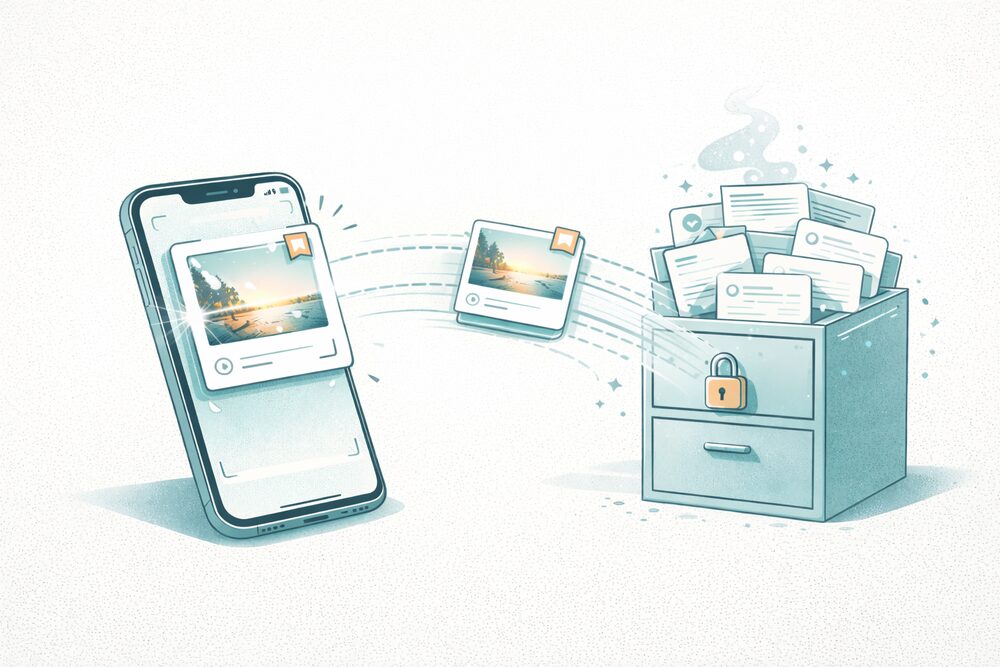
This is where Sorti reframes the screenshot. Instead of being a digital dead-end, a screenshot in Sorti becomes part of an organized collection. If it's a design inspiration, it lives with your other design ideas. If it's a product, it's organized with your other shopping saves. If it's a fitness routine, it's grouped with your health and wellness content. The AI reads what's in the screenshot, using OCR, image recognition, and content understanding, and places it in the right context automatically.
From Hopeful Hoarding to Confident Saving
By organizing screenshots automatically, Sorti transforms them from isolated images into part of a larger context. They stop being things you capture and never look at again. They become things you actually use. The recipe screenshot becomes part of your meal planning. The product screenshot becomes part of your shopping list. The travel screenshot becomes part of your trip planning.
The psychology shifts from "I'm saving this in case I need it" to "I'm saving this because I know I'll find it when I need it." That shift, from hopeful hoarding to confident saving, changes the entire relationship between you and your screenshots.