 ™
™
There's something deeply satisfying about a well-organized space. Whether it's a neat desk, a carefully curated wardrobe, or a clean kitchen, order feels good. It's not just about aesthetics, it's about clarity. When things are organized, you know what you have. You can find what you need. You can make better decisions.
Psychologists have studied this phenomenon extensively. Research on environmental order shows that organized spaces reduce cortisol levels and increase feelings of control. A Princeton study found that visual clutter competes for attention, reducing cognitive performance and increasing stress. The same principles apply to our digital environments, even though we rarely think about them that way.
Digital Clutter and Cognitive Load
Your phone is an environment. You spend hours in it every day. And for most people, it's a cluttered one. Hundreds of unsorted screenshots. Thousands of photos with no organization. Bookmarks from 2019 sitting next to ones from yesterday. Saved posts scattered across five different social media apps. Notes that were important once but now you can't remember why. This digital disorder creates a low-level background anxiety, a constant awareness that things are messy, that something you need might be lost, that you're not quite in control of your digital life.
This satisfaction extends to our digital lives, too. When your photos are organized, your files are easy to find, and your ideas are in one place, there's a sense of calm. You're not wasting mental energy trying to remember where things are. You're not frustrated by duplicate efforts or lost information. Everything just flows.
Automatic Organization Without the Work
The challenge is that achieving digital order has traditionally required significant effort. You have to create folders, decide on naming conventions, manually sort items, and maintain the system over time. Most people start organizing with enthusiasm and abandon the project within weeks because the maintenance is exhausting. The mess returns. The anxiety returns. The cycle continues.
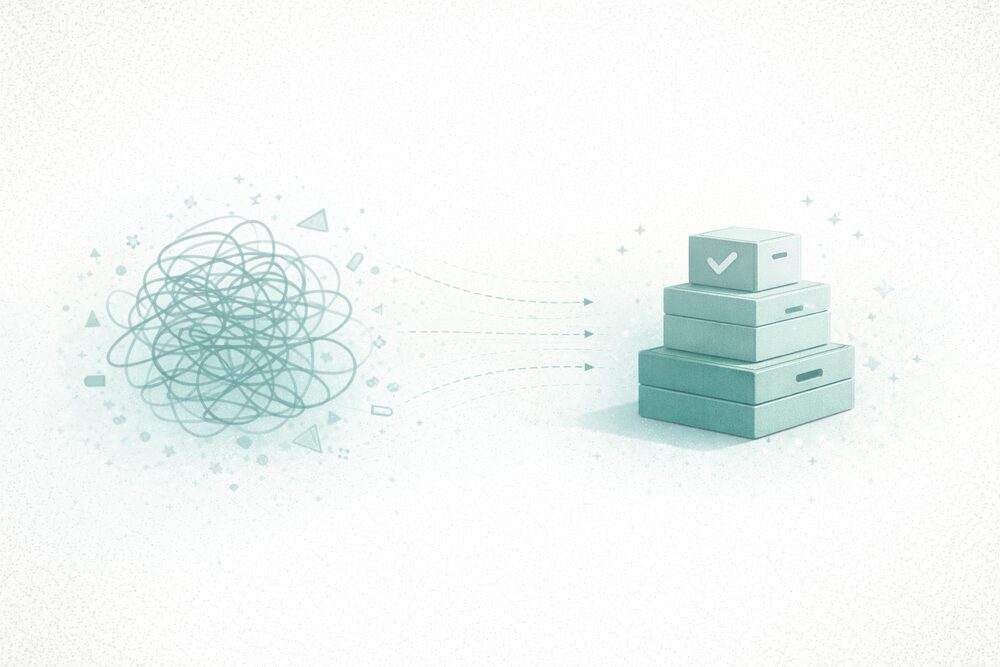
This is where automatic organization changes the equation entirely. When the organizing happens without your involvement, you get the benefits of order without the cost of maintenance. You save something, and it's organized. You save another thing, and it's organized too. Over time, without any effort on your part, a structured and browsable library builds itself around your interests and needs.
The Psychology of Digital Organization
Sorti brings this quiet satisfaction into your digital organization. As you save things, screenshots, links, photos, they automatically organize themselves into categories that make sense. Food content goes to your recipe collection. Products go to shopping. Travel ideas go to places. Design inspiration, fitness content, articles, everything finds its home. You don't have to do the organizing manually. The system does it for you. And the result is that peaceful feeling of having everything in order.
There's a compounding effect, too. As your organized collections grow, the satisfaction deepens. Opening your food collection and seeing 50 carefully categorized recipes feels different from scrolling through 50 random screenshots in your camera roll. One feels curated and useful. The other feels chaotic and overwhelming. The content is the same, the difference is the organization.
This is more than efficiency. It's about the psychological comfort that comes from knowing where everything is. It's the relief of having clarity instead of chaos. It's the ability to trust your system instead of worrying about what you've lost. It's opening your phone and feeling like everything is in its right place.
The quiet satisfaction of order, it's a feeling worth protecting. And with Sorti, it's a feeling that maintains itself.